
By Juanita Kwok
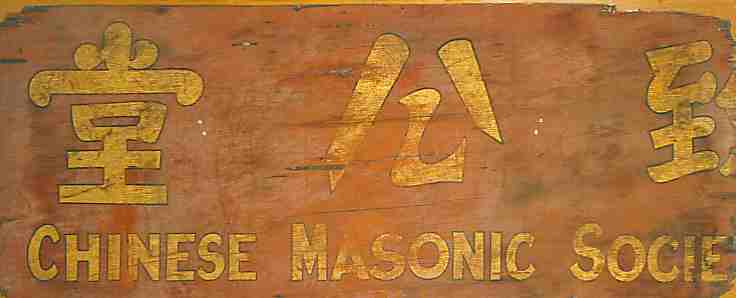
Chinese Masonic Sign (Albury City Collection ARM 92.009)
The Chinese Masonic Society is one of the earliest and largest and longest-continuing of Chinese Australian associations, established in the 1850s and still in operation, with its headquarters in Mary St, Surry Hills, Sydney. John Fitzgerald described its evolution “from a loose affiliation of rural clubs into an organised social network with a prominent urban profile”.[1] A report of the representatives who attended the grand opening of the Chinese Masonic Lodge at 18 Mary Street, Surry Hills on 30 January 1912 illustrates how widespread membership was in rural Australia:
The opening ceremonies commenced at 2 o’clock this morning when the Grand Master of the Society, Moy Sing, formally received the delegates from the different affiliate bodies in Melbourne, Brisbane, Bendigo, Rockhampton, Thursday Island, Auckland, Tasmania, Wagga, Wyalong, Temora, Nyngan, Braidwood, Moree, Mungindi, Condobolin, Hay, Parkes, Walgett, Newcastle, Wellington NSW, Albury, Wangaratta, Tumut, Tingha, Narrabri, Goulburn, Gunnedah, Wollongong, Lismore, Armidale.[2]
Besides those branches that sent delegates, there were many other affiliated societies which either had not yet been brought under the umbrella of the Chinese Masonic Society or had not sent representatives to attend, for example, Bathurst, Echuca, Atherton and Wellington New Zealand.
What would become the Chinese Masonic Society evolved over time and in the different places in which the society was active, it was known by different names over time. In Batavia, the Society was known as the Hung League, Hung Men 洪門 or tian-di-hui 天 地 會, the “Heaven and Earth League”, sometimes referred to as the triad.[3] Hung League pamphlets found in Singapore and Sumatra refer to the League as the Yee Hing 義興 “virtuous prosperity” company, (sometimes written Gee Hing or Ghee Hing).[4] In North America, the League was referred to as the Chinese Masons and in 1880, the name Chee Kung Tong 致公堂 “devote one’s efforts to the public” was first used in San Francisco in the US, and Barkerville and British Columbia in Canada.[5] The name Hongshuntang 洪順堂was used in Chinese language newspapers in Australia in the 1910s, whilst in the English language press the name Chinese Masonic Society or “Chinese Freemasons” was used.[6] In 1919, the Sydney headquarters of the Chinese Masonic Society, in accordance with the advice of the World Chinese Masonic Society in San Francisco, renamed itself the Chee Kung Tong.[7] That name was in use in Australia before 1919, as was the name Chinese Masonic Society, the English title officially adopted on the opening of the Chinese Masonic Hall in Sydney in 1912.
Branches of the Society existed in China, where the society had originated, in the Straits Settlements, USA, Canada, Mexico, Jamaica, Peru, Hawaii, Cuba and other places where Chinese men had migrated for work. The Chinese Masonic Society was part of a global, transnational network.
This is a continually evolving website, and more information will be published as further research is conducted. This research is the copyright of the author and no part of it should be published elsewhere without the express permission of the author.
[1] John Fitzgerald, Revolution And Respectability: Chinese Masons In Australian History, in Marilyn Lake and Ann Curthoys (eds) Connected Worlds: History In Transnational Perspective. Canberra: ANU Press, 2005.
[2] ‘Gee Hing.’, Evening News (Sydney, NSW : 1869 – 1931), 30 January, 1912, 4 , Viewed 12 Jul 2025, http://nla.gov.au/nla.news-article113823345
[3] Schlegel, G. The Hung League or Heaven Earth League : A secret society with the Chinese in China and India, Batavia:Lange & Co, 1866.
[4] Shaoqing Cai, From Mutual Aid to Public Interest: Chinese Secret Societies in Australia, in Sophie Couchman, , John Fitzgerald and Paul Macgregor (eds.) After the rush, Fitzroy Victoria: Arena Printing and Publishing Pty Ltd, 2004, 133-151.
[5] Bennet Bronson and Chiumei Ho, Coming Home in Gold Brocade: Chinese in Early Northwest America, (Seattle: Chinese in Northwest America Research Committee, 2015), 126.
[6] Fitzgerald, John, Big white lie: Chinese Australians in white Australia, Sydney, NSW, University of New South Wales Press, 2007.
[7] Yong, C.F. The New Gold Mountain: The Chinese in Australia 1901-1921, South Australia: Raphael Arts, 1977, 165